The Tabernacle and what it
represents
Part 7
In this article we will continue the
explanation and we shall talk about "The Pillars
and the Curtain of the Holy-place", "The Pillars and the Veil of the Most Holy of the Holy", and Why was the veil hanged under the golden clasps
of the twined linen cover of the tabernacle?
Exodus (26 –
36): And you shall make a curtain
for the entrance of the tabernacle of fine twined linen with blue,
purple and scarlet, embroidered with needlework.
37 And you shall make for the curtain five pillars of
acacia wood, and cover it with a layer of gold; their
hooks shall be of gold, and you shall
cast five bases of cupper
for them.
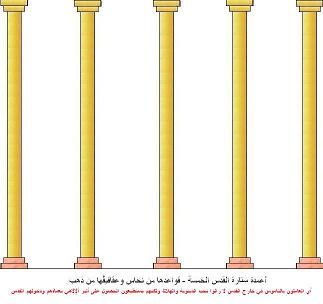
(C) - The
Pillars and the Curtain of the Holy-place: The curtain of the tent of meeting, that is
of the entrance of the Holy -place, was made of fine twined linen with sky-blue
, purple and scarlet, embroidered with needlework. And it
was hanged with hooks of gold upon five
pillars of acacia wood which were covered with a
layer of gold each standing upon a base of
cupper.
The pillars of the curtain were not fixed rigidly
with the walls of the tabernacle, for there is no mention of any bondage, but
they stand firm in their place carrying the curtain. This means that their
presence is temporary that
is they shall vanish as soon as mankind existence over the earth seizes,
that is when the second judgment begins. The pillars were made of wood
that means they are dead, but are covered with (gold) the goodness of God to preserve them forever.
Their bases were made of Cupper and their hooks of gold which means that the people
standing outside in the outside court are under
the judgment of death (Cupper bases) because none of them
is perfect and good, and they are still under the Law. But they can get eternal
life if they enter through the curtain through the four
spaces made by the five pillars of the entrance (Which represent the Four Corners of the world) and cross over to the
Holy-place.
The curtain was made of fine twined linen with sky-blue,
purple and scarlet, embroidered with needlework, which means that the entrance is
made possible through a heavenly King, a priest and a redeemer whose blood is splashed all over
the entrance to prevent the angels from destroying and killing whoever
accepts his redemption, and also whoever believed in his salvation and
offered what symbolized his sacrifice over the burnt offering altar
outside. The entrance is possible for all humans from the Four
Corners of the world.
(D) The
Pillars and the Veil of the Most Holy of the Holy
Exodus (26 –
31): And you shall make a
veil woven of fine twined linen with blue, purple, scarlet with cherubim; skilfully worked shall it be made,
32 and you shall hang it upon four
pillars of acacia wood covered with a layer of gold, with hooks of gold, standing upon four bases of silver.
33 And you shall hang the veil
under the clasps (hooks) and the loops, and put
the ark of the testimony (the covenant box) behind the veil; and the veil shall
separate for you the holy place from the most holy.
34 You shall put the mercy seat upon the ark of the
testimony in the most holy place.
35 And you shall set the table outside the veil, and the
candle-stick on the south side of the tabernacle opposite the table; and you
shall put the table on the north side.

(D) The Pillars and the Veil of the Most Holy of the Holy:
The veil was woven
of fine twined linen with sky-blue, purple, scarlet
with cherubim; skillfully worked. It was hanged by golden hooks upon
four pillars of acacia wood covered with a layer of gold, standing upon four
bases of silver.
The veil was hanged under the golden clasps and the loops
of the cover of the tabernacle, to separate the
Holy-place from the Most Holy of the Holy.
Now we ask:
First: Why was the veil placed under the golden clasps?
Second: Why was it named "a Veil" and not a Curtain, or Screen as was the case in the case
of the Holy-place entrance and that of the fence of the tabernacle?
Third: Why were the
Cherubim woven in the Veil and not embroidered
with needlework?
The four pillars
which carried the veil were made of acacia wood and covered with a layer of gold, that is they died but were given eternal life through the goodness of God. Each pillar
had a base made of silver and his hooks were made of gold,
which means that the believers who are in the Holy-place, stand in the Holy-place on the
basis of the redemption (Silver bases) and
they can get eternal life (golden hooks).
But they can not enter to stand before God as long as the veil exists,
because the cherubim on it will prevent and forbid them from doing so, and for
as long as they are ordered to guard the way to the Most Holy of the Holy.
As
seen in: Genesis (3 -24): He drove out
the man; and at the east of the Garden of Eden he placed the cherubim,
and a flaming sword which turned every way, to guard the way to the
tree of life.
This means that God
has placed the cherubim and ordered them to guard the Most Holy of the Holy to prevent whoever
tries to enter the heavenly throne. Even Aaron was not allowed to enter into
the Most Holy of the Holy except once a year on the great day of
atonement, and by the blood of sin offerings which he offered on
behalf of himself and the people of Israel, and in the same time he had to take
two handfuls of sweet incense and burn it on the fire before the Lord. (Lev. 16
-12).
So the veil was named as such, because it was placed
to make it not possible for men from seeing the heavenly throne or coming near
to it to see the face of the Almighty God who sits on it.
The veil was woven of fine twined linen with sky-blue,
purple, scarlet, and with cherubim , this meant that the
veil is from heaven and belongs to a heavenly King and priest. The cherubim
were woven within it to indicate that their
duty was to protect and guard the way to the heavenly throne.
The pillars on which
the veil was placed were four, and together they constituted and made
the three spaces of the entrance to the Most Holy of the Holy which
represented God himself, that is the Father and the Son and the Holly Ghost.
That is why Christ
said: John (14 - 6): "I am the
way, and the truth, and the life; no one comes to the Father, but by me."
To allow the believers who accepted the redemption of the Son of God to enter
the Most Holy of the Holy, God had to end the
mission and duty of the cherubim by putting an end for the reason of
the mission itself. And since the mission and duty of the cherubim was to
prevent the sinners (Adam and his descendants) from entering the heavenly
throne, then something had to be done to take away their sins and redeem them.
That meant that God should offer his promised Son
to fulfil the requirements of the godly justice. And this is just what God did,
he offered his Son who redeemed the believers by his crucifixion on the
cross, in order to take the punishment in their place. And we can see this in:
Matthew
(27 - 50): And Jesus cried
again with a loud voice and yielded up his spirit.
51 And behold, the veil of the temple was torn into two, from top to the
bottom; and the earth shook, and the rocks were split.
Also in: Luke (23 - 45): And the sun was darkened, and the
veil of the temple was torn in two.
46 Then Jesus, crying with a loud voice, said, "Father into your hands
I commit my spirit!"
Here the veil was
torn in two pieces, to allow the believers to
enter into the heavenly holy places, thus ending the mission and duty of
the cherubim. That is to make it possible for the believers to return and
to be able to stand once again before their creator and gain his acceptance and
satisfaction after covering their sins with the blood of the Son of God.
Now we ask, "Why was the veil hanged under the golden clasps of the twined linen cover of the tabernacle?"
Here we have to
understand what happens to the tabernacle when the veil is hanged under the
golden clasps. That is how the tabernacle is divided?
The tabernacle's
western side is made of six flat frames together
with a corner frame on either
side, that is the total of eight frames,
which is twelve cubits wide. So we expect that the Most Holy of the Holy
to be of a square shape whose side is twelve cubits, and since we have
twenty frames in each of the northern and southern sides of the tabernacle, so
we are left with twelve frames for the Holy-place, that is its length should be
eighteen cubits. But this is not the case,
for when the veil is hanged under the golden clasps it makes the length
of the Most Holy of the Holy in the northern and southern sides that of seven frames. So why was this? And what does it mean?
Since the frames
represent humans, then we should find out who is present in the heavenly
temple? Then we will understand what has actually happened with this division,
so we read in:
The Revelation (4 - 2):
At once I was in Spirit, and, behold, "A throne was set in
heaven , with one seated on the throne."
3 ..4 And round the throne were twenty-four thrones, and seated on the thrones were
twenty-four elders, clothed in white
garments, with golden crowns upon their heads.
And in: Zechariah (4 – 2):
And he said to me, " (Zechariah) What do you see?" And I
see, and behold, a lamp-stand all of gold, with a bowl on top of it, and
seven lamps on it, with seven pipes to the seven lamps, which are on its top.
3 And there are two olive trees by it, one on the right of the bowl and
the other on its left,
4 …11 Then I asked, " What are these two olive trees on the right
and the left of the lamp-stand?"
12 and a second time I asked, "What are these two olive branches,
from which their golden oil, through two golden pipes pours out?"
13 He said to me, "Don't you know what these are?" I said, "No,
my Lord."
14 then he said, " These are the two anointed
ones, who stand by the Lord of the whole earth."
The two olive trees
are the two anointed ones, who stand
before the Lord of the whole earth (Elijah and Enoch).
They are the two witnesses whom God will send at
the time of the end, firstly to prophesy and give witness to the people
of the world and secondly to give witness against them.
So by hanging the veil under the golden clasps, the northern and the
southern sides of the Holy-place became thirteen
frames each. That is the walls of the Holy-place were made of a total of
twenty-six frames. Which is exactly
equal to the twenty-four elders seated around the heavenly throne,
together with the two witnesses, that is the total number of twenty-six too. These twenty-six frames represent the
chosen ones from the seven chronological churches of God, who by their bondage
and unity together make the walls of the Holy-place, and are bound and
united with the frames of the Most Holy of the Holy. These chosen ones
represent the disciples and the prophets as in:
Ephesians (2 - 11):
Therefore remember that at one time you Gentiles in the flesh,
called the uncircumcision by what is called the circumcision, which is made in
the flesh by hands.
12 remember that you were at that time separated from Christ, alienated from
the commonwealth
of Israel, and strangers
to the covenants of the promise, having no hope and without God in the world.
13 But now in Christ Jesus you who once were far off have been brought near by
the blood of Christ.
14 For he is our peace, who has made us both one, and has broken down the
dividing wall of hostility,
15 by abolishing in his flesh the law of commandments and ordinances, that
he might create in himself one new man in place of two, so making
peace,
16 and might reconcile us both to God in one body through the cross, thereby
bringing the hostility to an end.
17 and he came and preached peace to you who were far off and peace to
those who were near;
18 for through him we both have access in one Spirit to the Father.
19 So then you are no longer strangers and sojourners, but you are fellow
citizens with the saints and members of the household of God,
20 you are built
upon the foundation of the apostles and prophets , Christ Jesus himself
being the corner stone,
21 in whom the whole structure is joined together and grows into
a holy temple in the Lord;
22 in whom you are also built, to make it a dwelling place for God in the
Spirit.
And also by hanging
the veil under the golden clasps, the northern
and the southern sides of the Most Holy of the Holy became seven
frames each. That is the walls of the Most Holy of the Holy were made of
a total of twenty-two frames. Which is
exactly equal to the number of cups (each with a capital and flower) of
the golden lamp-stand which represents the seven chronological churches of
God, (Three cups in each of the six side-branches and four
cups on the main shaft, that is a total of twenty-two cups ).
And now we ask,
"Why was the veil hanged under the golden clasps? What
is the function of the clasps?"
But we shall not
answer this question now and we shall do so after we have dealt with the covers
of the tabernacle.
In the next
part we shall talk about " The
covers of the tabernacle " .
Nori
Karim Daoud
25
/ 02/ 2009
|
|
|

