The Tabernacle and what it
represents
Part 8
In this article we will continue the explanation and we
shall talk about " The covers of the tabernacle
".
(9) -The Covers of the Tabernacle
Exodus (26 – 1):
Moreover you shall make the
tabernacle (the sacred tent) of ten cloth pieces
of fine twined linen woven with blue, purple,
scarlet and with cherubim skilfully worked shall you make them.
2 The length of each cloth piece
shall be twenty-eight cubits, and the breadth of each cloth piece four cubits;
all the cloth pieces shall have the same measure.
3 Five cloth pieces shall be coupled
and joined together; and the other five cloth pieces shall be coupled and
joined together.
4 And you shall make loops of blue
on the edge of the outmost cloth piece in the first set; and likewise you shall
make loops on the edge of the outmost cloth piece in the second set.
5 Fifty loops you shall make on the
one cloth piece, and fifty loops you shall make on the edge of the cloth piece
that is in the second set; the loops shall be opposite one another.
6 And you shall make fifty clasps (hooks) of gold, and join the
two sets together into one piece.
7 You shall also make cloth pieces of goats’ hair for a tent over the
tabernacle; eleven cloth pieces shall
you make.
8 The length of each cloth piece
shall be thirty cubits, and the breadth of each cloth piece four cubits; the
eleven cloth pieces shall have the same measure.
9 And you shall couple and join five
cloth pieces together, and six cloth pieces together, and the sixth cloth piece
you shall double fold over at the front of the tent.
10 And you shall make fifty loops on
the edge of the cloth piece that is outmost in one set, and fifty loops on the
edge of the cloth piece which is outmost in the second set.
11 And you shall make fifty clasps (hooks) of cupper, and join the two sets together into one piece.
12 And the part that remains of
the cloth pieces of the tent, the half cloth piece that remains, shall hang
over the back of the tabernacle.
13 And the cubit on the one side,
and the cubit on the other side, of what remains in the length of the cloth
pieces of the tent shall hang over the sides of the tabernacle, on this side
and that side, to cover it.
14 And you shall make for the
tent a covering of rams’ skins dyed red, and a covering above it
of tachas’ skins.
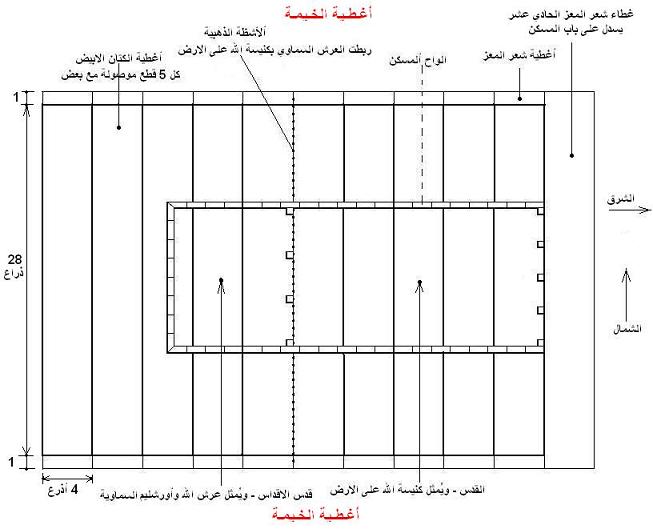
(9) -The Covers of the Tabernacle:
The covers of the
tabernacle (the holy tent), represent the different stages of the exodus of mankind out of the slavery and
bondage of sin and its consequent punishment to reach
God’s redemption and salvation in order to get the opportunity to stand
once again in God's presence.
And we shall deal
with the covers beginning from top downward in the direction of the
Most Holy of the Holy.
(A) -The
Cover of the Tachas’ skins:
The colour of the
cover of tachas' skins (Dolphins skins) is a blackish
dark blue. And since the dolphins were created before man, this
meant that the salvation and redemption plan
was laid out before the creation of man, because God had the prior
knowledge of what Adam and Eve will do. That means, "this cover
symbolized the stage that proceeded Adam's fall in sin".
(B) -The
Dyed Red Cover of Rams’ Skins:
The cover of the
rams' skins which were dyed red, that is the skins of the symbolic
sacrifices which started with the sacrifice from which God had made the
garments with which he covered Adam's and Eve's genitals (to cover their
shame and sin).
Men started to offer
these sacrifices beginning with Abel's offering and till the time when
the Commandments and the Law were given to Moses on the top of Mount Sinai. This stage was symbolized by the ram, which was given to Abraham to offer it
instead of his son Isaac on the top of Mount Moriah.
These sacrifices
were offered as a symbol to the promised sacrifice of God's
Son. Which means that this cover symbolized the
stage of the fall in sin and its slavery.
(C) -The
Cover of the Woven Goats' Hair:
Goats' hair is
usually of a black colour, which means that he who offers these
sacrifices repents and is sorry for his
over trading of the Commandments and the Law. The cover symbolized the
sin offerings, which were offered in accordance with
the Law that God gave to Moses and all mankind, and which the Israelites
accepted and agreed to work according to its terms. That is the sacrifices that
were offered as a symbol to Christ's crucifixion and redemption. That is
this cover symbolized the stage of the Commandments and the Law, as from Moses and
till the coming of Christ and the crucifixion of the Son of God to
redeem mankind and to give them a new easy way for salvation.
The cover was made
of eleven cloth pieces; the length of each
cloth piece was thirty cubits, and a
breadth of four cubits. The First six cloth
pieces were coupled together to make one piece of them. Also the five
cloth pieces that were left were coupled together to make them into one
piece. Fifty loops on the edge of the cloth piece that is outmost in one
set, and fifty loops on the edge of the cloth piece which is outmost in the
second set were made of the same material of the cover itself. The two
sets were joined together by fifty clasps
of cupper to make the
tent into one whole.
The sixth cloth piece was double folded over the front of
the tent, and the part that remained of the cloth pieces of the tent,
the half cloth piece that remained, was hanged over the back of the tabernacle.
And the cubit on the one side, and the cubit on the other side, of what
remained in the length of the cloth pieces of the tent were hanged over the
sides of the tabernacle, on this side and that side, to cover it.
The cupper clasps mean that he who follows the Law is still under judgment of death, because his offering only
symbolizes the offering of the Son of God. He is still required to
accept the sacrifice of the Son of God and to declare his belief in him.
The cupper clasps were placed directly
over the golden clasps of
the twine linen cover of the tabernacle.
(D) -The Twined Linen Woven cover:
This cover was made of ten cloth pieces of fine
skillfully worked twined Linen woven with blue, purple, scarlet and with
cherubim. Each cloth piece was twenty-eight
cubits, and its breadth was four cubits, and each five cloth
pieces were coupled and joined together to make them into one piece.
Fifty loops of blue were
made on the edge of the outmost cloth piece in the first set; and likewise on
the edge of the outmost cloth piece in the second set. The loops of one set
were made opposite to those on the other set. And fifty golden clasps were made to join the two sets together into one
piece to make the tabernacle into one whole.
This tabernacle is a house
of priesthood redeemed with the blood of a heavenly King and
cherubim guard it. No one can enter it except through the torn veil and
through the three spaces made by the pillars, which were placed, between the Holy-place and the Most Holy of the Holy.
Which means the cover symbolizes the
stage of salvation by Christ's
blood.
We notice that the
book names the twined linen cover as the
tabernacle (the house) and the
cover of the goats' hair as the tent. And when it says the tabernacle is made into one whole it means that the Holy-place and the Most Holy of the Holy became
into one whole (because the only thing that separated the two was the
veil that was hanged under the golden clasps).
This means that God has connected and bonded, The Most Holy
of the Holy which symbolizes his throne which
is in heaven with the Holy-place which
symbolizes the seven chronological churches
of God which are here on earth. And since the loops were made of sky blue colour and the clasps of gold, this
means that God has connected his heavenly throne
by heavenly loops and bonds with his church on
this earth. So the angels began to guard all the seven branches of God's
chronological church from the time of Christ crucifixion and till his glorious
Second Coming.
God
has also connected and bonded, The Most Holy of
the Holy with the Holy-place during
the stage of the Law (clasps of
cupper) temporary, under the condition of offering
the sin animal sacrifices in accordance to the Law and the ten
commandments, which
only symbolized the redeeming cross offering of the Son of God, to make the tent into one whole.
But as you see the tent is temporary and it was erected
by the Israelites during their travel through the desert, and which was
replaced by (the house) which is permanent.
The chronological
order, which God the Almighty has used to describe the different articles to be
made and the parts of the tabernacle in the bible, is different from that we
have followed. God began First: by the
ark of covenant and the mercy seat then the bread table then the golden
lamp-stand. Second: the tent, its different covers, its walls, and the Holy-place
and the Most Holy of the Holy. Third: the burnt
offering altar. Fourth: the fence of the
tent of meeting. Fifth: the priests
cloths. Sixth: the incense altar. And
seventh:
the cupper laver.
The order that God
has used is the same as the chronological order of the
stages of the exodus of mankind from under the slavery of sin, that
God had planed. That is, the essence and foundation of the exodus of
mankind from under the slavery of satin is first: The redemption of the Son of God and its
symbol is the Ark of the Covenant .
Through his redemption we were given his flesh
to eat and his blood to drink, that we
may live by them. That is by the bread and the wine
that are on the table. Then the seven
churches of God represented by the lamp-stand
light s the way for all mankind and distributes the bread of life
to all its believers and priests. This is actually the whole salvation plan.
Second: God described how the
heavenly throne was looped, bonded and connected through the redemption to the church of God on earth. God described the
place of the saints and believers in the Holy-place
and in the heavenly temple.
Third: God began to
explain how men could get the salvation through out the different stages of the
exodus, that is in the beginning they are under the judgment of death
and they offer the sacrifices that symbolize the sacrifice of the Son of God while
they are still outside the fence.
Fourth: by offering the
sacrifices that point out to the redemption of the Son of God while they are in
the stage of the burnt animal offerings altar that is the stage of
the Law.
Fifth: those who seek
salvation should become priests and enter into the Holy-place that is to stage of the redemption
by the cross.
Sixth: Then they should
have faith and belief, they should pray, kneel and give thanks to
God and be the salt of the earth. And
finally seventh:
they should keep their bodies and souls pure and clean, (as the
salvation is for both the body and soul) which means they should be baptized
in Christ blood. So you see the third, fourth, fifth, sixth and seventh were to
tell how the salvation plan is executed throughout the generation to save all
those who believe.
In the next
part we shall talk about why the different articles made for the
tabernacle were placed in their specified places ,
as asked by God. And the pillars of the entrance
of the Tent, the pillars of the curtain of the Holy-Place,
and the pillars of the Veil of the Holy of
the Most Holy, and finally the golden
clasps which
connected the heavenly throne with the church of God on this earth.
Nori
Karim Daoud
25
/ 02/ 2009
|
|
|

